Diogenes by Inger N. I. Kuin
/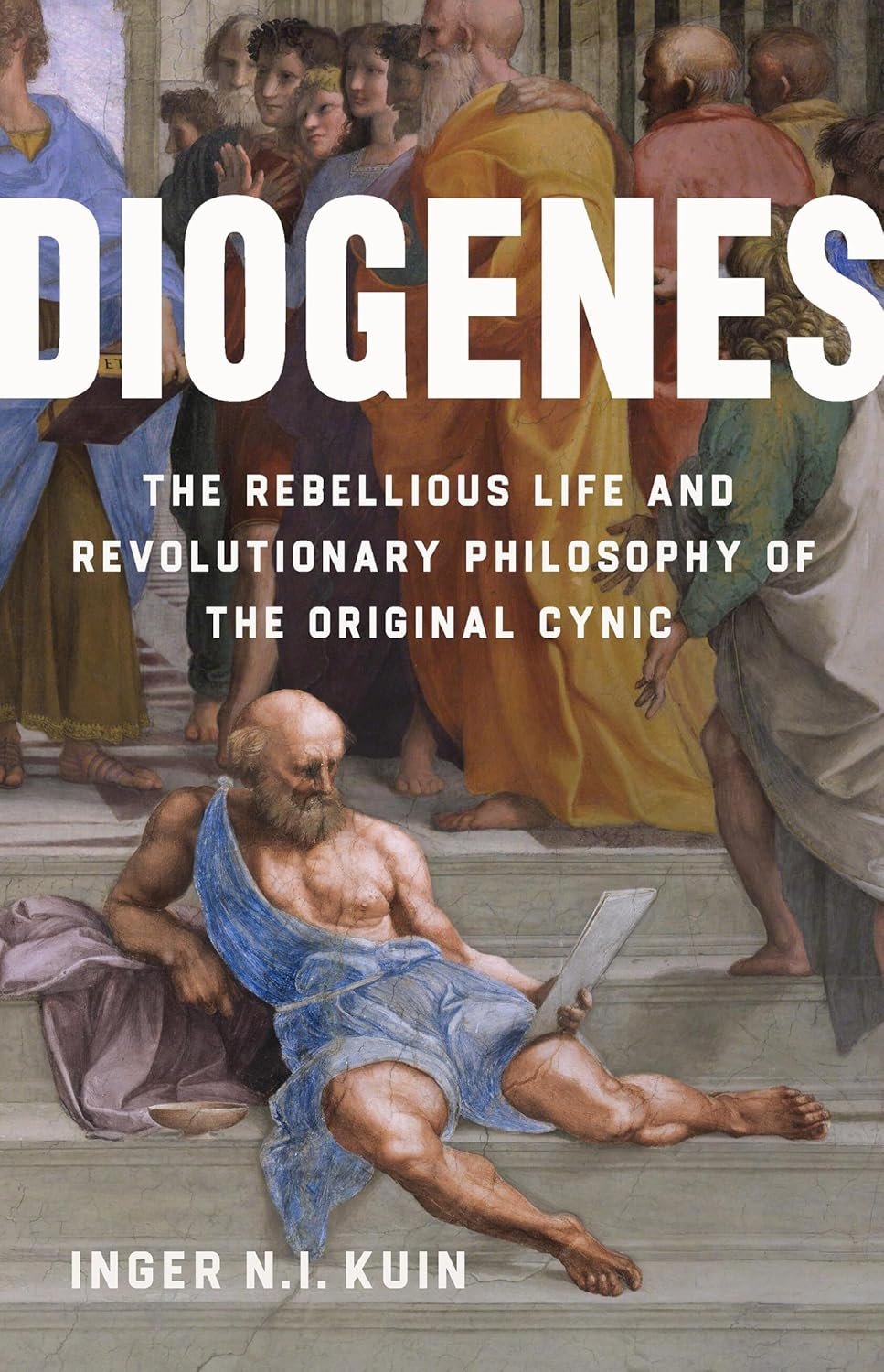
Diogenes: The Rebellious Life and Revolutionary Philosophy of the Original Cynic
Inger N.I. Kuin
Basic Books 2025
Diogenes, the 4th Century BC philosopher dubbed by his contemporary Plato as "the Dog", is the subject of UVA professor Inger N.I. Kuin's new eponymous biography which aims to clear the acrid air surrounding the oft-misunderstood provocateur. While known to historians as the leading figure of the school of Cynic philosophy, the life of Diogenes usually appears to modern audiences through the tales of his "intentionally spectacular deeds and equally memorable quips," to include his public displays of defecation and masturbation (even 23 centuries ago these were taboo acts) as well as his infamous encounter with Alexander the Great in which he lazily told the mighty conqueror to "step aside, out of my sun." "Diogenes' fearless and irreverent response to the most powerful man in the world as it was known to him encapsulates everything that he stood for,” writes Kuin, “total independence, courage in the face of power, and joyful contentment with what nature bestows freely on us humans."
Growing up in the city of Sinope (in what is now northern Turkey), at that time on the periphery of the Greek and Persian civilizations, Diogenes was exiled from his homeland due to an incident involving the defacement of currency, and he was forced to make his way westward to the heart of Greece, Athens (and later Corinth), where he took up residence in a large earthenware jar near the public marketplace. And while Diogenes profiles exactly as one might imagine a 21st Century urban vagrant, this ascetic lifestyle was a choice in pursuit of "living in accordance with Nature," a popular contrivance cited by many schools of philosophy (mainly Stoicism) in the post-Socrates Mediterranean world. Where Diogenes and the Cynics differed from other groups was in the interpretation of "Nature," which was not then a representation of God or Reason, but simply that of nature itself, the natural universe.
There is an earnest pragmatism to Diogenes' philosophy and his slapstick refutations of theoretical inquiries by his more academically-minded Greek contemporaries like Plato and Eubilides of Miletus demonstrate his knack for emphasizing the importance of the physical world. It's not surprising that Diogenes admired the austere Spartans, though his propensity to devolve into anti-intellectualism feels like a whoopee cushion: funny in the moment, yet its only strength is begotten by deflation. But if, as Kuin puts it, "Diogenes was indeed a raving, out-of-control Socrates to the extent that he went even further in choosing poverty, devotion to philosophy, and independence from the city," then it's no surprise that he clashed with Plato, a man born of wealth and known for cozying up to tyrants in Syracuse and living well above his means.
It must be acknowledged that despite his lived-in philosophy of simple living and self-sufficiency, Diogenes was a man of baffling paradoxes and hypocrisies, many of which have simple practical answers that are ignored by both cynic successors and Kuin alike. To take defecation as an example, Diogenes, ever the social rebel, condemned the shameful gap between ingestion, digestion, and excretion as an unnatural phenomenon. Why do we hide away the toilets but not the dinner table? The answer appears obvious to anyone with a nose: poop is smelly and unsanitary and it attracts wild critters. Even granting that relieving oneself is as natural a process as eating, the philosophical hoops that Kuin and later commenters jump through to explain the wild acts of Diogenes feel cheap when considering his arrant devotion to the practical.
Unlike non-writing ancient philosophers like Socrates and Epictetus, whose teachings were respectively transcribed by Plato and Arrian, Diogenes has no surviving works and is only written about lengthily centuries after his death in a series of quasi-apocryphal biographies. Kuin seeks to unearth the true Golden Mean of historical Diogenes, somewhere between sanitized and sensationalized, and yet her arguments for historicity often fall short of convincing. For such a mythical figure it would be easy to fall into the trap of waxing lyrically about his various encounters, yet Kuin pens a steady, unromantic style of prose that sometimes borders on austerity:
Diogenes, as we know, was homeless. He slept in his large jar in the marketplace in the center of town. He refused to lecture, let alone take students in any formal capacity. Anyone who wanted to ask him something could do so. All they had to do was show up. He had no books to his name.
Where Kuin missteps is her final chapter's afterthought of noting the separation between the Ancient World philosophy of "Cynicism" and the modern attitude of "cynicism," which belays a mistrust of the motivations of humanity towards self-interest, far different from the self-sufficient and virtue-driven philosophy of Diogenes. This failure to distinguish terms, bolstered by the biography's subtitle, "The Rebellious Life and Revolutionary Philosophy of the Original Cynic," may do more harm than help in resurrecting Diogenes' reputation from being anything other than the homeless guy who pooped in public and yelled at pedestrians.
Diogenes is a work that sifts through the apocrypha, hypocrisy, and inflammatory behavior of an ancient philosopher who stressed the importance of living well in the here and now. Transparent to the point of abasement and fiercely anti-authoritarian, Diogenes should be a valiant icon in a 21st Century that is increasingly trading honor and ethics for blind loyalty.
Vincent McGean is a part-time freelance reviewer living in Washington, DC.